
Shingles Blew Off My Roof After a Storm? Now What?
The storm’s passed, you’re walking the yard, and there it is: a shingle in the flower bed. Maybe two. And now you’re standing there holding a piece of your roof, doing the math on what this means, and the math feels expensive.
Take a breath, this is one of the most common, most fixable things that happens to a roof, especially on the shore, and it is almost never the disaster it feels like. This post walks you through exactly what to do, what to skip, what it costs, and how to know if yours is the rare case that’s actually urgent. By the end you’ll know more about wind and shingles than most of the guys who’ll knock on your door after the next storm.
Is a missing shingle an emergency?
Usually, no. And knowing why will lower your heart rate.
Your shingles are not the only thing keeping water out of your house. Underneath them is a layer called underlayment, a water-shedding layer across the roof deck. When a tab blows off, that layer may keep shedding water temporarily. It is not designed to serve as the finished roof, so a missing tab still needs prompt repair, even when it is not a five-minute emergency.
There are three versions of this problem that ARE urgent, and they’re easy to spot:
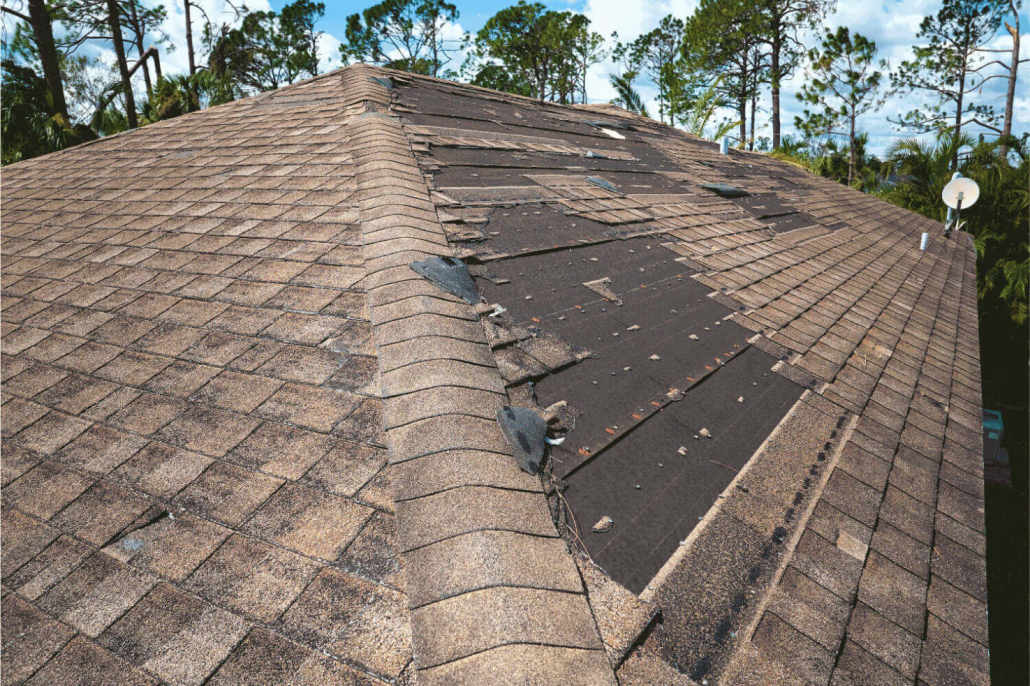
You can see wood. If the gap shows bare plywood instead of black or gray membrane, the underlayment went with the shingle, and rain now has a direct path in. Same-day call.
Water is already inside. A stain spreading on a ceiling, a drip in the attic, damp insulation. The storm found a way in. Same-day call.
A whole section is gone. One or two tabs can be localized wind damage. A patch the size of a doormat or bigger suggests the wind got under the field of shingles, and more may follow in the next blow.
If none of those three apply, you have a this-week problem. Handle it before the next storm, but sleep fine tonight.
How do I check my roof without getting on it?
Don’t get on it. This is the most important sentence in this post. A roof that just took a storm may be wet, and wet shingles and ladders create serious fall hazards. Everything you need to see right now can be checked from the ground or a safe window.
Here’s the walk. Circle the house slowly and look up at every roof plane:
Look for dark patches. A missing tab exposes the darker layer underneath, so gaps read as dark rectangles against the shingle field. Morning or evening light makes them easiest to spot.
Look for lifted or crooked shingles. Wind doesn’t always remove a shingle. Sometimes it just breaks the seal and leaves the tab sitting loose or cocked at an angle. Those are the next ones to go.
Look at the metal. Flashing, the metal at chimneys, walls, and roof edges, that’s bent, lifted, or ticking in the breeze took wind damage too, and flashing failures leak worse than missing tabs do.
Check the ground and the gutters. Count what came down. Granules washing out of the downspouts in quantity, it looks like coarse black sand, means shingles took a scouring even where nothing blew off.
Then check the attic only if it is safely accessible and clear of electrical hazards. Use a flashlight and look at the underside of the roof deck for water marks, damp spots, or daylight showing through anywhere it shouldn’t. Stay on framing or a proper walkway. Water travels along the framing before it drops, so follow any stain uphill only where you can do so safely.
Ten minutes, feet on the ground, and you now know which category you’re in.
Why do shingles blow off in the first place?
Worth understanding, because it tells you whether this is a one-off or a pattern.
Every shingle tab is held down two ways: nails at the top, and a strip of factory adhesive that bonds each tab to the one below it once the sun heats it. That seal is what actually fights the wind. Wind doesn’t push shingles off a roof, it gets under an edge and pries, and a sealed tab gives it no edge to grab.
So when tabs start coming off, one of a few things is true. The roof is new enough that the seals hadn’t fully set yet, common if it was installed in cold weather. The roof is old enough that the seals have dried out and let go, which is normal aging. The nails underneath have worked loose or were driven wrong to begin with. Or the wind simply exceeded what the shingle was rated for, which on this coast, with a nor’easter running two days straight, happens to perfectly good roofs.
One or two tabs after a serious blow can be localized damage: fix them and have the surrounding roof checked. Tabs coming off in ordinary weather, or after every storm, are a pattern, and that usually means the seals or fasteners are failing beyond the spot where the evidence landed in your yard.
Can rain get in through the spot where shingles are missing?
Eventually, yes, and here’s the part people get wrong: it won’t look like rain getting in.
You may not see a drip in the living room the next time it rains. What happens instead is quieter. Water finds the nail holes in the exposed underlayment, wicks in a little at a time, and lands on your attic insulation, where ten inches of fiberglass absorbs it invisibly. It soaks in, dries out, soaks in again. The plywood around those nail holes stays damp longer each cycle. This can run for months or longer before a stain ever reaches a ceiling, and by then the repair isn’t a shingle tab anymore, it’s plywood.
That’s the real reason a missing tab is a this-week problem instead of a someday problem. Not because the house necessarily floods right away, but because the meter starts running quietly the day the tab leaves, and slow water damage becomes expensive precisely because nobody sees it happening.
Should I call my insurance company about missing shingles?
Honest answer: for a few tabs, usually not, and knowing why protects you either way.
For a few missing tabs, the repair may cost less than your deductible, so filing a claim may not make financial sense. Document everything first, then check your policy or speak with your insurer if the damage may be broader.
But do this today regardless: photograph everything. The shingles in the yard, every dark patch on the roof from the ground, anything in the attic, all with your phone, which date-stamps automatically. Here’s why it matters even when you don’t file. Wind damage is sometimes bigger than it looks from the ground, and if a contractor gets up there and finds the storm did real damage, creased shingles across a whole slope, torn flashing, wind-driven rain intrusion, you may have a legitimate claim after all. Dated photos from the day of the storm are valuable evidence.
And if it does turn into a claim, document the damage before repairs and contact your insurer promptly. Estimates can help, but they should follow a clear record of what the storm damaged. Get the roof professionally inspected, keep the photos and measurements, meet the adjuster when possible, and compare contractor bids with the adjuster’s report before settling the claim. Whoever inspects your roof, make sure they photograph everything and give you the file. Those photos are yours.
How much does it cost to replace blown-off shingles?
Usually modest by roofing standards. Replacing a shingle tab is often a small, standard repair once safe roof access is established. The material costs little; most of the price reflects the service visit, safe access, inspection, and proper installation.
The honest pricing picture: the cost of a standalone visit varies by contractor, access, roof pitch, and the amount of surrounding damage, while the replacement material itself costs very little. The catch to watch for is the opposite direction, the storm-chaser math, where a knock on the door after a blow turns three missing tabs into “you need a whole new roof.” A few missing tabs do not, by themselves, prove that. If anyone tells you it does, make them show you photographic evidence of failure across the roof, decking, widespread seal failure, not just the gap you already knew about. A real diagnosis comes with pictures.
For what it’s worth, this exact repair is one of the reasons the Gutter Cleaning and Roof Tune-Up exists. Pricing starts at $199 for homes with two levels or fewer above ground and is $324 for three-story homes. The homeowner must be present for the appointment. It includes up to five replacement shingle tabs, plus flashings re-secured and sealed, nail pops set, the gutters cleaned, and 30–40 photos of the roof, attic, and gutters. After a storm, that’s usually the efficient move: the tabs get fixed and you find out what else the wind did while the technician is up there, documented. But the plain math stands on its own: tabs are cheap, whoever fixes them.
Can I just glue the shingle back on myself?
We’ll be straight with you: people do, and we understand the instinct, but we can’t recommend it, for two reasons that have nothing to do with wanting your business.
The first is the ladder. A one-story ranch with a walkable pitch on a dry day is one thing. Anything steeper, higher, or damp is genuinely dangerous, and the shore’s wind doesn’t help. Falls from roofs and ladders are among the most common serious DIY injuries there are, and no shingle tab is worth it.
The second is that the blown-off tab is usually a symptom. Wind that took one tab often broke the seal on its neighbors without removing them, and loosened nails you can’t see from the gap. Gluing the visible tab back down with a blob of roofing cement, the classic move, treats the evidence and leaves the condition, and the next blow finishes the job. A proper repair replaces the tab, checks and reseals the tabs around it, and looks at why the seal failed in the first place.
Even on a low roof, the repair requires secure ladder access, fall protection, correct shingle placement, and proper sealing. If you do not have that equipment and experience, stop at the ground-level inspection and hire a qualified roofer. The repair is small; the fall risk is not.
Why does this keep happening to my roof in Ocean City?
Because nothing stands between your roof and the Atlantic. This is the part of the story that’s specific to where you live.
Inland Maryland gets weather. The shore gets weather with a running start: nor’easters that blow for two days straight, hurricane remnants riding up the coast, and the everyday onshore wind, from the boardwalk high-rises down to West Ocean City and out toward Assateague, that never fully stops. Wind out here doesn’t need a named storm to work on a roof. It pries at tab edges a little at a time, every day, and the salt air is simultaneously aging the adhesive seals and the exposed sealants faster than they age inland.
So a shore roof can lose tabs sooner and more often than the same roof would farther inland. That’s not a defect in your roof, it’s the trade of living at the water: the value is immense, and the sea is relentless. What it means practically is that shore roofs are maintenance-sensitive. The small details, seals, flashings, gaskets, fasteners, fail early out here, and they’re all cheap to catch and brutal to ignore. A once-a-year look at those details is the whole game on this coast. When shore roofs fail early, it is often the unchecked small details, not the ocean alone, that do the damage.
For the full breakdown of what this coast does to a roof, wind, salt, humidity, ice, all of it, read our guide, Roofs on the Shore.
One visit that handles all of it
If you’ve read this far, you know what needs doing: the tabs replaced before the next blow, the shingles around them checked, and honestly, after a storm that took shingles, your gutters are carrying that storm’s debris right now too.
That’s the whole idea behind the Gutter Cleaning and Roof Tune-Up. An AROCON roof technician or team handles the visit, and the shingle repair is included, up to five tabs, matched as closely as your roof allows, with the neighboring tabs checked and resealed while the technician is up there. The roof and gutter system is blown off, the gutters and downspouts are re-tightened using existing fasteners and brackets, and the gutter slope and ground drainage are checked. And the whole time, the technician is looking at everything: the flashings, the pipe gaskets, the nail pops, and the small details the wind works on that you can’t see from the yard.
You get 30–40 photos of all of it the same day. What the storm did, what got fixed, what’s fine. No wondering, no taking anybody’s word for anything, and a dated record of your roof’s condition sitting in your pocket if this storm or the next one ever turns into an insurance conversation.
The repair alone is worth a visit. The trained eyes are what the visit is actually for: someone experienced with shore roofs, spotting the loose flashing today that would’ve been the ceiling stain in two years. That’s the peace of mind part, and around here, it’s the whole game.
What should I do right now?
The whole post in one checklist:
- Stay off the roof. Everything you need to see is visible from the ground.
- Walk the house and look up. Dark patches, crooked tabs, bent flashing. Check the attic with a flashlight if you can.
- Photograph everything today. Yard debris, roof from the ground, anything in the attic. Date-stamped phone photos.
- Sort your urgency. Bare wood, water inside, or a doormat-sized patch missing: call someone today. A tab or two with the membrane intact: this week.
- For a few tabs, a claim may not make financial sense. Keep the photos and check your deductible and policy if the damage turns out to be broader.
- Get the tabs replaced before the next storm, by someone who checks the neighboring shingles while they’re up there, and make sure whoever goes up gives you photos of everything they find.
If you want it all handled in one visit, the tabs, the flashing, the neighbors checked, the gutters cleaned while they’re there, and the full photo record in your hands the same day, that’s exactly what the Gutter Cleaning and Roof Tune-Up is. Pricing starts at $199 for homes with two levels or fewer above ground and is $324 for three-story homes. The homeowner must be present for the appointment. An AROCON roof technician or team handles the work, and you stop wondering what else the wind did.

