
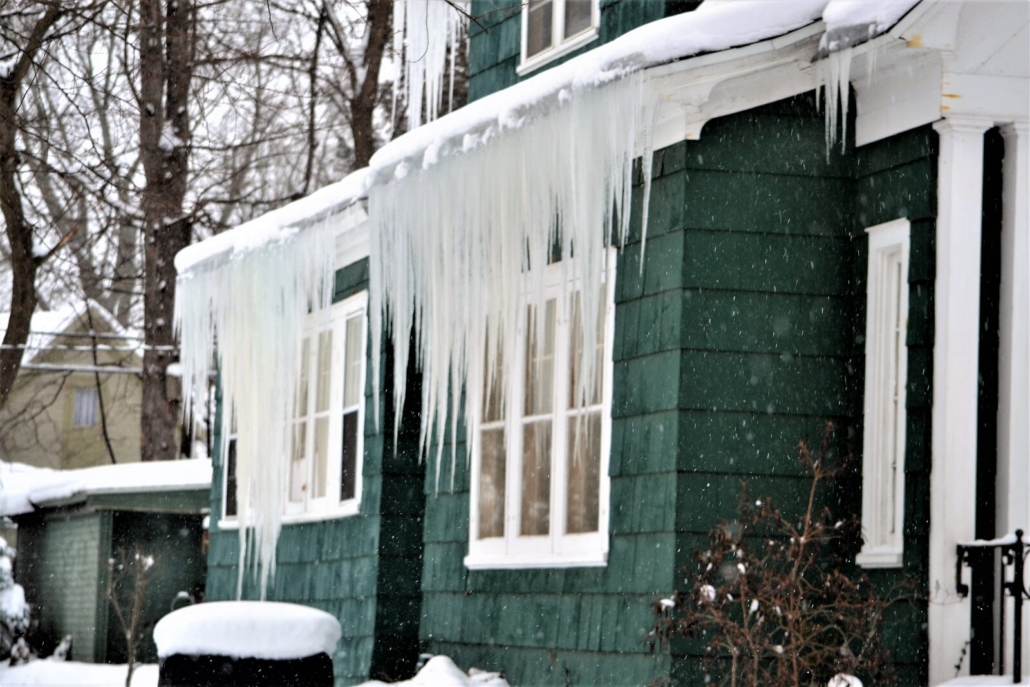
Ice Dams on the Shore: Why Beach Homes Get Winter Leaks
Cold snap comes through in January. Two days later there’s water coming down a wall in a house that never leaked before, and the roof looks fine from the driveway.
That’s an ice dam, and beach houses get them. Not the way Vermont gets them, but they get them, and the version we get out here has its own cause.
The bigger problem is what happens next. Most of the ice dam damage we find in April didn’t come from the ice. It came from somebody trying to get the ice off.
Do beach houses even get ice dams?
Yes, less often than inland, and they behave differently.
A classic ice dam needs sustained snow cover and heat escaping into the attic, which melts the snow from underneath. The water runs down, hits the cold overhang past the exterior wall, and refreezes into a ridge. Then everything melting behind that ridge has nowhere to go, so it backs up and looks for a way in.
Out here you don’t get weeks of snowpack. You get freezing rain, a hard freeze behind a wet nor’easter, one snow that half melts and then locks up overnight. Different ingredients, same result at the eave.
What causes an ice dam on a shore house?
Usually the gutter, which is why this is the one winter problem you have real control over.
A gutter packed with pine needles doesn’t drain. Water sits in it. Temperature drops, that water freezes into a solid block along the whole run, and now the bottom edge of your roof has a wall of ice sitting on it. Everything coming down the slope stops there.
Under the canopy in Ocean Pines, Berlin or West Ocean City, gutters fill with needles by November whether or not you were there to see it. That’s the setup.
The other half is heat getting into the attic. Older frame cottages downtown, anything with a converted attic space, anything with insulation that got wet years ago and packed flat, all of that leaks warmth into the roof deck and starts the melt. See mold in the attic and what it usually means.
Low slope makes both worse. Water moves slower on a shallow pitch, so it has more time to freeze.
Does where my house sits change the risk?
It changes it a lot, and the highest-risk houses out here aren’t the ones on the water.
Under the canopy. Ocean Pines, Caine Woods, Berlin, Bishopville, West Ocean City. This is where ice dams actually happen on the shore. Needles pack the gutters by November, shade keeps the roof from ever drying or clearing, and what freezes up there stays frozen for the length of the cold snap. Ocean Pines adds a second problem, since a lot of that housing went up starting in 1968 and plenty of those attics are still working with original insulation and marginal ventilation. Packed gutters plus a warm attic is the whole recipe.
Oceanfront and oceanside. North Ocean City, the blocks near the boards, Fenwick Island. Wind works in your favor here, since it scours snow off the roof before it can sit and melt from below. What you get instead is freezing spray and wind-driven rain icing up at the eave, on fasteners and flashing that salt air has already been working on all year.
Downtown, below 33rd Street. Older frame cottages, converted attic space, knee walls and dormers. Dormers and valleys are where meltwater collects and refreezes, and a finished attic room means heat is going straight into the deck above it.
Bayside and canal lots. Heron Harbour, Sunset Island, Mallard Island. Less wind than the oceanfront, so snow sits. Low slope is common, and water moves slower on a shallow pitch, so it has more time to freeze before it reaches the gutter.
Montego Bay and the low-slope stretches at the north end. Little to no attic space means the ceiling sits right under the deck, so heat transfers directly and there’s no cold buffer between the two.
One more thing that surprises people. The sunny slope can build a worse dam than the shaded one. A north face that stays frozen all week doesn’t move any water. A south or west face melts every afternoon and refreezes every night, and that daily cycle is what stacks ice at the eave.
Why did water come through the ceiling during a cold snap?
Because backed-up water sat on the roof long enough to find a seam.
A roof sheds water that runs down it. It isn’t built to hold standing water against the shingle courses, and that’s what an ice dam creates. Water works backward under the tabs, through a nail hole, past flashing that was fine under normal conditions.
Then it shows up somewhere that makes no sense. Down a wall, around a window, in a room on the other side of the house from the ice. Water travels along framing before it comes through drywall, so where you see it isn’t where it got in.
Can I knock the ice off myself?
You can. This is where most of the damage happens, and almost none of it is visible until spring.
Cold asphalt shingles are brittle. Warm shingles flex, cold ones crack, and below about 40 degrees they’ve lost most of their give. So everything you do up there in January does more harm than the same action in June.
What we find in the spring:
- Chopped shingles. Hammer, hatchet, ice pick, garden spade. The ice doesn’t separate cleanly from the roof, it separates with granules and pieces of shingle mat still frozen to it. You get punctures and split tabs under where the ice was.
- Torn tabs at the eave. Ice grips the shingle surface. Lever a chunk off and it takes the tab edge with it, or breaks the seal strip so the tab is loose and free to lift in the next wind.
- Gutters pulled off the house. A gutter full of ice is already carrying more weight than it was built for. Chop at it, or lean a ladder on it, and the fasteners let go of the fascia. Now the gutter’s hanging and the fascia’s open, and it stays that way until somebody looks in April.
- Footfall cracks. Walking a frozen roof cracks shingles under your weight in a pattern nobody notices until it leaks.
- Falling ice. The chunk you free up lands on a deck rail, a window, an HVAC unit, a car, or a person standing below.
- Ladder falls. Ladder, ice, cold hands, frozen ground. This is the one that puts people in the hospital and it happens every winter.
Then April comes and the roof leaks. Whoever diagnoses it a season later sees split shingles at the eave and calls it winter damage, because a hatchet mark and a storm look the same once the ice is gone. That’s how a fixable roof turns into a replacement quote.
Same goes for the guy your property manager sent over with a hammer while you were in Baltimore. He was trying to help.
What about rock salt or ice melt on the roof?
Skip it.
Rock salt and calcium chloride corrode metal. On a roof that means your flashing, your drip edge, the fasteners holding everything down, and the gutter itself. Out here those parts are already fighting salt air year round, so you’re adding to a problem the coast started. See does salt air wear a roof out faster.
It also runs off into whatever’s planted below, and it can stain siding on the way down.
The one version pros sometimes use is calcium chloride in a fabric sleeve laid across the dam so it melts a channel without scattering. It works. It also means getting to the eave, which puts you back on a ladder in winter.
What about hot water or a heat gun?
Hot water refreezes.
You melt a channel, the water runs down onto a colder section, and by morning you’ve built a second dam lower on the roof than the first one. You also drove a volume of water under the shingle courses to do it.
Heat guns and torches near a roof edge sit next to dry framing, dry decking, and whatever’s in the soffit. People have burned houses down doing this.
Steam is the correct tool, low pressure steam run by somebody who does ice removal, which melts the ice without touching the shingles. If you’re going to pay somebody, pay for that and not for chipping.
Should I use a roof rake?
A plastic one, from the ground, on the lower few feet, pulling rather than scraping. That’s the safe version and it does help.
The failure modes: metal blades scrape granules off, a rake caught under a tab tears it, and anything above the first few feet means a ladder. If you can’t reach it standing on the ground, you’re done.
If it’s below freezing and the shingles are brittle, gentle still cracks things. On a cold roof the least damaging option is often to manage the water inside and deal with the roof once it warms up.
Why does the damage show up in April instead of January?
Because most of it doesn’t leak while it’s frozen.
Ice is a seal. A split tab or a punctured shingle under a block of ice isn’t going to run water until the ice is gone. Then the first warm rain finds the opening, and by then nobody connects it to the cold snap three months back.
On a house you live in you might notice a stain in February. On a house that sits closed until April, the first person to see anything is you, standing in a hallway wondering how long that’s been happening. See why second home leaks go unnoticed for years.
What prevents them?
One of them you can knock out this fall.
Clear gutters going into winter. No standing water in the trough means no block of ice on the eave. On a needle-heavy lot this is the whole ballgame, and it’s why the fall visit matters more than the spring one. See why gutters overflow every storm.
A cold attic. Ventilation working, insulation intact and not compressed, gaps around lights and fans sealed so warm air isn’t rising into the roof deck. A roof that stays the same temperature as the air outside doesn’t melt snow from below.
Heated cables at the eave get sold as a fix. They melt a channel, they don’t stop the dam, they cost money to run, and they’re a maintenance item of their own. Fine as a last resort on a problem eave that’s already been looked at. Not a first step.
The $199 tune-up does both prevention steps in one trip: gutters cleared so the eave can drain, and an attic check for warm air getting into the roof deck.
Or call 410-861-6767. A person answers, 7 days a week.
My place sits empty all winter. Does this apply to me?
Differently, and part of it works in your favor.
Heat off means a cold attic, so you’re less likely to get the classic melt-from-below dam than a neighbor who’s home all winter with the thermostat up.
What you still get is the gutter version. Needles, standing water, freeze, ice on the eave. That happens whether anybody’s home or not.
If the heat is on low to keep pipes from freezing and the insulation is poor, you get the melt anyway. Nobody’s there to see water come through a wall either, so it runs the rest of the winter and you find it in April.
Which is why the fall visit is the one to book if you’re only booking one. See what owning a place at the shore takes to maintain.
What it costs to get ahead of it
$199.
The Gutter Cleaning and Roof Tune-Up is full gutter cleaning, a complete roof inspection, a complete attic inspection where there’s access, small repairs handled on the spot when it makes sense, and 30 to 40 photos of the roof, the gutters and anything documented.
For ice dams specifically, that visit does both prevention steps at once. Gutters come out so the eave can drain, and somebody’s in your attic looking at whether warm air is getting up there in the first place.
Book it in the fall. October and November, before the first freeze, on a house that’s about to sit empty for five months.
A person answers when you call. They’ll ask what’s going on, get you scheduled for a day that works, and the visit runs about 60 to 90 minutes. Anything bigger than a small repair, you get an estimate and you decide. Nothing past the $199 unless you say so.
18 years doing this. 2,400+ Google reviews across all our locations, 4.8 stars.
We cover Ocean City, Ocean Pines, West Ocean City, Berlin and Bishopville, and up the Delaware side through Fenwick Island, Bethany, Dewey, Rehoboth and Lewes.
Full gutter cleaning, complete roof and attic inspection, small repairs on the spot, and 30 to 40 photos. October and November, before the first freeze.
Or call 410-861-6767. A person answers, 7 days a week.
Frequently Asked Questions
Which houses get ice dams worst on the shore?
Properties under pine canopy inland, meaning Ocean Pines, Caine Woods, Berlin and West Ocean City. Needle-packed gutters, shade that keeps ice from clearing, and older attics with marginal ventilation. Oceanfront houses get less snowpack because wind scours the roof.
Do beach houses get ice dams?
Yes, less often than inland and from different causes. Instead of weeks of snowpack, the shore gets freezing rain and hard freezes behind wet storms, and clogged gutters that freeze solid along the eave.
What damage does chipping ice off a roof cause?
Split and punctured shingles, torn tabs at the eave, broken seal strips, granule loss, and gutters pulled off the fascia. Cold shingles are brittle, so damage happens easily and usually doesn’t leak until spring.
Can I put rock salt or ice melt on my roof?
It corrodes flashing, drip edge, fasteners and gutters, and runs off into landscaping. Coastal roofs are already exposed to salt year round.
Does hot water get rid of an ice dam?
No. It refreezes lower on the roof and builds a second dam, and it drives water under the shingle courses in the process.
Is a roof rake safe?
A plastic rake used from the ground on the lower few feet, pulling rather than scraping, is the safe version. Metal blades strip granules, and anything requiring a ladder in winter puts you on ice for a cosmetic gain.
How do I stop ice dams from forming?
Clear gutters before winter so there’s no standing water to freeze at the eave, and keep the attic cold with working ventilation, intact insulation and sealed air gaps.
Do heat cables fix ice dams?
They melt a channel rather than removing the cause, they cost money to run, and they need their own upkeep. Reasonable as a last resort on a problem eave, not as a first move.

