
Black Streaks on Your Shore Roof: It’s Algae, Not Dirt (Don’t Pressure-Wash It)
You’ve been living with those streaks for who knows how long.
Dark stripes running down the roof, worst on one side, looks like somebody dumped dirty water up there. Every time you pull in the driveway you see it and think, yeah, I gotta deal with that at some point.
Okay. Good news first. It’s not dirt. And it’s not eating your roof.
It’s algae. It’s alive, it’s growing on your shingles, and it’s there because that side of your roof stays damp. Which out here, near the water, describes just about everybody.
The algae is a sign. It grew there because that slope holds moisture, and moisture is what causes the stuff you can’t see from the driveway. Those streaks are just the part that’s visible.
So don’t panic, nobody’s roof is falling in because it’s got streaks on it. But don’t ignore the message either, right? Your roof just told you something about itself that’s worth finding out what.
What are the black streaks on my roof?
Gloeocapsa magma. That’s the name. Now you never have to think about it again.
It’s a blue-green algae, a cyanobacteria technically, and it travels through the air. Lands on your roof, conditions are right, it sets up shop and multiplies. The black you’re looking at is a dark coating the stuff makes to protect itself from UV. That’s why it shows up hard on a light roof and you can barely see it on a dark one.
What’s it eating? The limestone filler in your shingles. Not the asphalt, or the mat. The powdered limestone they mix in as filler. That’s why it’s on your roof and not on your siding.
And it runs downward because rain carries it down the slope. That’s the tell right there. Streaks running down, wider at the bottom, following the water.
Is the algae itself hurting my roof?
Barely. And look, I could tell you it’s destroying your roof and you’d probably book something today. I’d rather you trust me later.
Two real effects. It holds moisture, so a living colony on your shingles keeps them damp longer after rain than a clean roof would. And it darkens the roof, so the roof takes on more heat, which in August at the beach is a small hit to your attic.
That’s it. That’s the whole damage story for the algae itself. It doesn’t eat through shingles. It wont cause leaks. It does not turn a 25 year roof into a 12 year roof on its own.
So if somebody’s telling you the streaks are destroying your roof, they’re either wrong or they’re working you.
Now read that first effect again. It holds moisture. And why is it there in the first place? Because there was already moisture. Which is the whole reason we keep going here.
So what are the streaks telling me?
The slope they’re on stays wet.
Algae grows where water sits. And a roof that stays wet? That’s where things go wrong overtime, in spots you can’t see standing in your yard.
That’s what’s worth caring about here. Those streaks are free information. Your roof is pointing right at the slope that isn’t drying out, and everything expensive that ever happens to a roof starts with water that stayed somewhere too long.
What kind of hidden problems does moisture cause?
Here’s where it stops being cosmetic. And here’s why somebody’s gotta actually get up there, because almost none of this is visible from the ground.
- Decking going soft. Under your shingles is plywood, and that’s what every nail on your roof is driven into. Damp gets into that wood, it goes spongy. And guess what? You can’t repair rotten decking. There’s nothing left to fasten to.
- Nails corroding. Thousands of nails hold your roof down. Wet salty air out here works on every single one. Nails that lose their grip are how shingles come off in a wind that never should’ve taken them.
- Moss moving in. Stay damp long enough and flat algae gives way to moss, which stands up, holds real water, and lifts the shingle edges. A lifted shingle is a wind problem sitting there waiting on a nor’easter.
- The bottom edge sitting in water. If your gutters have been jacked up, that lowest couple feet of roof has been standing in water for months. On a shore house that’s exactly where rot starts. See why gutters overflow every storm.
- Attic moisture and ventilation. Sometimes the roof won’t dry because the attic under it isn’t breathing. That shows up as staining on the underside of the plywood, insulation matted flat, and eventually mold. See mold in the attic and what it usually means.
- Insulation that quit. Wet insulation doesn’t insulate. You’re paying for that every month and you’d never connect it to your roof.
Every one of those gets found the same way. Somebody gets on the roof. Somebody gets in the attic. And it’s somebody who’s seen a few thousand of these and knows what a soft spot feels like under his boot and what a stain on decking means.
None of it’s visible from the driveway.
Why is it only on one side of my house?
Because algae wants what it wants and one side of your house is handing it over.
North-facing slopes, every time. Less sun, so that side stays damp longer after every rain and every morning fog. It means one slope dries slow.
Same deal under a tree line or along the low edge of the roof where water sits longest before it gets to the gutter.
The slowest-drying slope on your house is where moisture damage shows up first.
Why do shore roofs get it worse than roofs inland?
Because you live in a place built for it.
Humidity off the water all season long. Morning fog that sits up there for hours. Warm months that run long. Loblollies around West Ocean City and Berlin shading half the roofs in the neighborhood and dropping needles that hold damp right against the shingles.
The spores travel through the air and your neighbors are close. Once it’s on one roof on the block, it’s on the block. Drive around out here and you’ll see whole streets where every third house has the same streaks running down the same slope. That’s not the builder’s fault and it’s not yours.
Same shingles, same year, one house at the beach and one 60 miles inland. They will not look the same and they will not last the same. That’s the coast. Point being basic hygiene is the solution. Keep it clean, get it inspected from time to time.
Is it algae, moss, or lichen?
This matters, because the answer changes what you do about it. First, look at the texture, not the color.
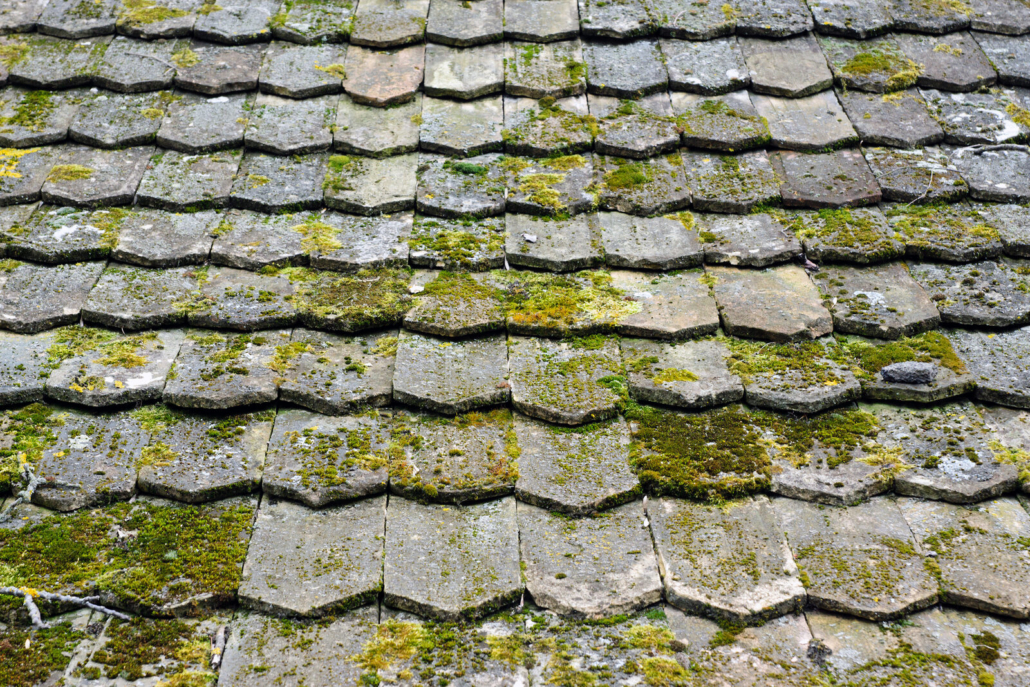
Algae. Flat. Stains the surface, no height to it. Runs downward in streaks. Black or dark gray. On its own, cosmetic. This is what most people have.
Moss. Green, fuzzy, stands up off the roof. You can grab a handful. Moss is the one that’s actually a problem, because it holds real water against the shingle and it grows in under the edges and lifts them. You’ve got moss, don’t file it under cosmetic.
Lichen. Crusty circular patches, greenish gray, looks painted on. Lichen roots into the shingle mat and it does not come off easy, and cleaning it usually takes granules with it. Generally leave it be unless the roof’s near replacement anyway.
Flat streaks running down, that’s algae, you’ve got time. Fuzzy and standing up, that’s moss, worth handling. Crusty patches, that’s lichen, and going after it aggressively does more damage than the lichen was doing.
Can I pressure wash it off?
No. And of everything on this page, this is the one I’d ask you to actually take seriously.
Your shingles are protected by granules. That layer of little ceramic-coated rocks on the surface. Granules are the sunscreen. They’re the only thing standing between the asphalt and the UV that wants to cook it. Granules come off, that shingle’s on a clock.
A pressure washer strips granules. Not maybe. Not if you do it wrong. That’s what the tool does. So somebody blasts the streaks off, the roof looks fantastic for about a week, and they just took five or eight years off it. You’ll find the granules piled up at the bottom of the downspout after. That tells you exactly what happened.
Two more things. Pressure washing drives water up under the shingle courses, which is the opposite of what a roof’s built to handle. So congratulations, you just added moisture to a slope that already had a moisture problem. And most manufacturer warranties throw out damage from pressure washing, so if you ever needed that warranty, you just spent it on how your roof looks from the street.
Somebody shows up with a pressure washer and a ladder and quotes you a roof cleaning? That’s not a roofer. Send him home.
What gets algae off, and who should be doing it?
Low pressure and a chemical solution. The industry calls it soft washing and it’s what the shingle manufacturers themselves point you to.
Roughly 50-50 water and regular chlorine bleach. Applied gently, let it sit a bit, then rinse it off with plain water at garden hose pressure. No scrubbing. No brushing. No blasting. The bleach kills the organism, the rinse carries it off. That’s the method. It works.
Now here’s where I tell you to hire somebody, and it isn’t because we’re protecting a service.
A roof with bleach solution all over it is the slickest thing you will ever stand on. Granules under wet feet are like ball bearings before you add anything to them. Now add soap. Now add a ladder set in soft spring ground against a two story. That’s the setup that fills up emergency rooms every fall, and for what? This is a cosmetic job. Nobody should get hurt over how their roof looks from the road.
Hiring it out, two questions get you most of the way. Ask them to confirm it’s soft washing and not pressure washing. And ask what they’re doing about the runoff.
On the runoff. Bleach kills landscaping, so soak your plants down first and rinse them after. And this is where being at the shore matters more than it would anywhere else. That runoff goes to the storm drains and the storm drains go to the coastal bays, and the bays are carrying plenty already. Contain what you can, rinse hard, and don’t do it right before a downpour.
Last thing, know this going in. Soft washing kills what’s up there right now. It does not stop it coming back, because the spores are still in the air and your north slope still dries slow. You’re buying a few good-looking years. You’re not buying permanent. Anybody selling permanent is selling.
Ground-level stuff you can absolutely handle yourself, and it actually helps: keep the tree limbs off the roof so that slope gets sun and air, keep the gutters flowing so the bottom edge isn’t sitting wet, and shoot a photo of the roof from the same spot every spring so you can tell whether it’s spreading or just sitting there. See what owning a place at the shore takes to maintain.
Do zinc strips work, or is that a gimmick?
They work. They’re slow, and they’re not a rescue.
Strip of zinc or copper up near the ridge. Rain hits it, runs down the slope carrying metal ions, algae doesn’t want to grow in that. Copper’s better than zinc. Either one only protects what’s below it, so a strip at the ridge does the slope and a strip halfway down does half a slope.
It’s preventive, not corrective. Keeps a clean roof clean, won’t undo streaks you already have. And it takes a season or two of rain to show you anything, so nobody puts one up and sees a result this month.
Worth it on a roof that just got cleaned or just got replaced. Not worth it as a fix for what’s already there.
And if you’re anywhere near replacement, algae-resistant shingles are real, not a gimmick either. Copper granules mixed right into the surface, warrantied against streaking for a stretch of years. Out here, where the climate’s basically an algae incubator? That’s an upgrade that pays. Bring it up when you’re at that conversation, not before. See do I need a repair or a full replacement.
My roof’s supposed to last 25 years. Why do people end up replacing them prematurely?
Because a rating and a lifespan are two different things.
3-tab asphalt, you’re generally good for something like 20 to 25 years. Architectural, call it 25 to 30, more on the premium stuff. But those numbers assume a roof that’s ventilated, drains right, dries out between rains, and gets the small stuff handled as it comes up.
Out here? Plan on the low end of whatever your shingle’s rated for. Wind, UV off the water, wind-driven rain, salt, long humid months. They all take their cut.
And the roofs that go way short of their rating almost never got taken out by one big thing. They got there on small things nobody handled. A pipe boot that dry rotted in year nine. A gutter that hasn’t moved water in three seasons. A slope that never dried out, on a house nobody was standing in.
So that’s the real math on a roof. You’re not choosing between spending money and not spending money. You’re choosing between small money on a schedule and a five figure check that shows up years before it had to. Replacement runs somewhere in the 10 to 20 thousand range once you’re there.
Look, it’s like having a good mechanic. When you’ve got a good mechanic, it’s not a catastrophe when something goes wrong with the car, right? Same thing with a roof. It’s not a catastrophe if a shingle blows off. You’re not about to get ragged over the coals. You call, a friendly tech comes out, he deals with it. That’s peace of mind, and peace of mind is most of what you’re actually buying.
An ounce of prevention is worth a pound of cure. You’ve heard it. It’s still true, and it’s more true on a house sitting in salt air.
I own a rental at the shore. What should I be doing?
Getting eyes on the roof twice a year. And it’s different for you than for somebody living in the house year round, so let’s be specific about why.
You’re not there. Nobody’s standing in the hallway when a stain shows up on a ceiling. Your cleaning crew isn’t getting on a ladder and honestly it isn’t their job. Nobody’s home during the nor’easter. And the house sits empty through exactly the months when the weather’s worst. Everything that happens to that building happens with nobody watching. See why second home leaks go unnoticed for years.
So the rhythm is spring and fall. Spring to see what winter did before guests are in the house. Fall to clear the gutters and close the gaps before the place sits by itself. Only doing one? Do the fall one.
And for an owner who lives somewhere else, the photos are the whole thing. You should never be taking anybody’s word about a roof you’ve never stood on. Start a folder, put every report and every set of pictures in it, never delete anything. That folder settles an insurance claim faster than an argument does. It answers the buyer’s inspector when you sell. And it keeps every contractor honest, us included. See what owning a place at the shore takes to maintain.
This is just hygiene, same as getting the HVAC looked at. You’ve got serious money sitting in that building. The roof’s the most expensive part of it and it’s the part nobody ever looks at.
Do I have to do anything about the streaks themselves?
Honestly? A lot of you don’t.
Flat algae, you’re not selling, you’re not renting it out, and you don’t personally hate looking at it? Then leaving those streaks alone is a completely defensible call. It’s cosmetic. It’s going to stay cosmetic. Go spend that money on something else.
- You’re listing the house. Streaks read as neglect to every buyer pulling in the driveway, and to plenty of inspectors too. That’s leverage you’re handing over for free, and a soft wash before the photos is cheap next to what it costs you at the table. See the pre-listing roof check.
- You rent it out. Guests judge a house from the driveway. That one’s just business.
- It’s moss, not algae. Different situation, and moss should get handled.
Keep the two decisions separate, because they’re not the same decision. Cleaning the streaks is about how your house looks. Getting eyes on the roof is about what those streaks are telling you. First one’s optional. Second one isn’t.
What if I just want somebody to look at the roof?
That’s the $199 Gutter Cleaning and Roof Tune-Up. And let me be clear about what it is and isn’t so nobody’s surprised.
It’s not a roof washing. The tune-up isn’t going to take your streaks off.
What it is: full gutter cleaning, complete roof inspection, complete attic inspection where there’s access, small repairs handled right then while we’re up there, and 30 to 40 photos so you can look at your own roof instead of taking somebody’s word for it.
Which is exactly the right thing for what this page is about. The streaks are cosmetic. What that moisture has been doing to your decking, your nails, your bottom edge and your attic is not. And that’s what somebody standing on your roof and sitting in your attic actually finds.
This happens all the time:
Somebody calls about the streaks. They say, well, the roof’s 20 years old anyway, I figured I’d just replace the whole thing and be done with it.
And I say, look, let’s start with the tune-up. $199. We get up there, we clean the gutters out, we look at everything, we take the pictures, and then you actually know what you’ve got. If you need the roof, you’ll know, and you’ll have the photos that prove why. If you don’t, guess what? You just saved yourself north of ten grand.
And if you like how we treated you on the tune-up, we’re right here when the replacement day comes.
That’s it. It’s not complicated. Give people the service, get it done, they’re stoked, it’s over, and we’re here for whatever comes next.
A person answers when you call, by the way. Not a robot, not a phone tree. They’ll ask what’s going on out there, get you on the schedule for a day that works, and our team calls ahead when they leave the last job. About 60 to 90 minutes. Then the photos come to you. Anything bigger than a small repair, you get an estimate and you decide. Nothing past the $199 unless you say so.
18 years doing this. 2,400+ Google reviews across all our locations, 4.8 stars. Go take a look at what your neighbors are saying.
Not a roof washing: a complete roof and attic inspection with the gutters cleaned, small repairs on the spot, and 30 to 40 photos of what the moisture has really been doing.
Or call 410-861-6767. A person answers, 7 days a week.
Frequently Asked Questions
Are black streaks on a roof dangerous?
The streaks themselves are cosmetic. What matters is what they’re telling you, which is that the slope stays damp, and moisture is what drives decking rot, corroding nails and attic problems you can’t see from the ground.
Why does algae grow on a roof at all?
It travels through the air and it feeds on the limestone filler in asphalt shingles. It takes hold where a roof dries slow, which is why shaded and north-facing slopes get it first.
Can I pressure wash algae off my roof?
Don’t. A pressure washer strips the granules that protect the shingle, forces water up under the courses, and typically voids the manufacturer warranty. Soft washing at low pressure is the right method.
What actually removes roof algae?
Roughly 50-50 water and chlorine bleach, applied gently, left to sit, then rinsed at garden hose pressure. Soak the landscaping first and rinse it after, never mix bleach with other cleaners, and hire it out rather than standing on a wet slick roof yourself.
Will the streaks come back after cleaning?
Eventually, yes. The spores are still in the air and a shaded slope still dries slow. Cleaning buys you good-looking years, not permanence. Zinc or copper strips near the ridge slow it down going forward.
How do I tell algae from moss?
Algae is flat and runs downward. Moss is green, fuzzy and stands up off the surface. Moss lifts shingle edges and holds water against them, so moss is worth handling where algae mostly isn’t.
Should I get the roof looked at if all I’ve got is streaks?
It’s worth it, especially on a rental or a second home. The streaks are cosmetic, but they’re marking the slowest-drying slope on the house, and that’s where moisture damage shows up first. A tune-up gets somebody on the roof and in the attic and puts 30 to 40 photos in your hands.

