
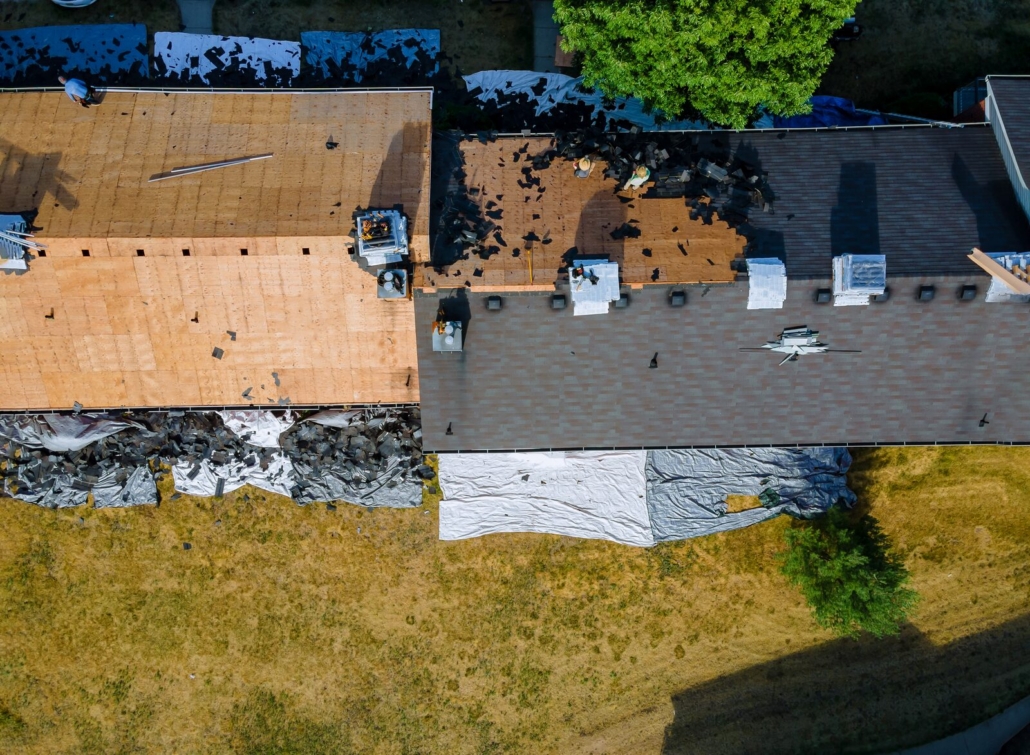
Wind Damage or Just an Old Roof? How to Tell What Took Your Shingles
You’ve been standing in the yard holding a piece of your own roof for about five minutes.
It came off sometime in the night. The roof looks fine from down here, which is somehow less reassuring than if it looked bad.
That piece in your hand is the best evidence you’ve got. Here’s how to read it.
It blew hard Tuesday night and now there’s shingle pieces in your yard.
Everybody asks the same question. Did the storm do this, or was my roof already cooked and the storm just finished it off?
One of those answers might be a claim. The other one’s a maintenance bill. You can’t tell which from the couch, but you can get pretty close from the ground once you know what you’re looking at.
It’s leaking right now. What do I do tonight?
Inside first.
Move what’s under it, put a bucket down, and if you’ve got a bulge in the drywall, that’s water pooling above it. A small hole with a screwdriver at the low point drains it into your bucket instead of letting the ceiling come down in one piece. That feels wrong and it’s the right call.
Photograph everything before you clean any of it up. The wet ceiling, the bucket, the water, the outside of the house, the yard.
Then leave the roof alone until daylight and dry weather. Nobody should be on a wet roof in the dark, and a tarp thrown on badly does more damage than the hole it’s covering, because it traps water and the fasteners holding it down are new holes in your roof.
Call in the morning and say it’s actively leaking. That changes how you get scheduled.
What does wind damage look like on a shore roof?
Wind damage has tells, and they’re specific once somebody points ’em out.
Clean breaks. A tab ripped off in wind tears at the edges. The break looks fresh, granules are still stuck on it, the color’s still good, and the piece in your yard doesn’t crumble when you pick it up.
Creases. Wind gets under a shingle, lifts it, slaps it back down, and leaves a fold line across the tab. Looks fine from the ground. That crease is a crack in the mat and it’ll leak in a year or two with the shingle still sitting up there. Most people don’t know to look for it.
Exposed nail heads and a shiny strip. When a tab pulls off you can sometimes see the nails, plus the adhesive strip where the shingle above it was sealed down. Fresh break.
It’s bunched in one spot. Wind hits your house from a direction, so damage clusters on one slope, usually up high, usually along the edges, the rakes, the ridge. Wind gets its best grip on corners. Everything messed up on one face and the other side looking new is a wind story.
How long do I have before missing tabs turn into a leak?
Less time than the roof looks like it’s giving you, and it depends on what’s underneath.
Under your shingles is underlayment, felt or synthetic. It’s water resistant and it’s the reason a missing tab doesn’t leak the same night. It isn’t a roof, though. Felt degrades in sun and wind in a matter of weeks once it’s exposed, and it tears at the nail line. Synthetic buys longer, months rather than weeks, and still isn’t a plan.
The bigger issue is the nails. When a tab pulls off, the fasteners holding the course below it are often exposed, and a nail head sitting in the weather is a direct path into the decking. That’s how a few missing tabs turn into stained plywood over a winter.
Practical answer: a couple of tabs missing in April on a dry stretch, you’ve got time to schedule it properly. The same tabs missing in October, going into five months of nor’easters on a house nobody’s inside, get them handled before the house closes up.
What does an old roof look like when it lets go on its own?
Different picture, and it’s usually the more common one.
Everything’s the same amount of bad. Age doesn’t pick a side. Both slopes look tired. Maybe south and west look a little worse where the sun’s been beating on ’em, but there’s no hot spot.
Curling and cupping. Edges lifting all over the roof, corners turning up like an old sandwich. That’s fifteen years of sun, not one storm.
Bald patches. Granules are the sunscreen. When they wash off you get dark shiny spots where the asphalt’s cooking in the UV. You’ll find the granules piled at the bottom of your downspouts.
The piece in your yard crumbles. Pick it up. Brittle, cracks when you flex it, edges rounded and worn instead of torn clean? That shingle didn’t get taken. It quit.
Nail pops, dried caulk, a split pipe boot. Wear shows up everywhere at once because it’s all the same age.
Wind damage shows up in one place on a date. Age shows up everywhere at the same slow speed.
Which slope should I check first?
Depends on what kind of storm it was, and out here that’s a useful shortcut.
Nor’easter. Sustained winds out of the northeast, sometimes for a day or two. Check the north and east faces first, and check the rake edges on those slopes. These are the ones that do the most shingle damage on the shore, and they hit in the months nobody’s in the house.
Summer squall line or thunderstorm. Those move west to east, so the hit comes off the back side of the house if you’re facing the water. Check west and northwest faces.
Tropical system. Depends entirely on the track, so check everything. But start high and start at the edges.
Then look at where the pieces landed in the yard. Debris downwind of the house tells you which direction the wind was pushing, and that points you at the slope it came off.
Why’d I only lose shingles on one side of the house?
That’s the side the wind hit, and it works in your favor.
Wind doesn’t blow evenly across a roof. It pushes up at the edges and grabs whatever’s already a little loose, so uplift starts at a rake edge or a corner and peels inward from there, like it found a lip and got its fingers under it.
Damage bunched on one slope that starts at an edge is a clean storm story.
Tabs missing on every side of the house is a different situation. That’s a roof where the seal strips gave out and pieces are coming off wherever they feel like.
Does where my house sits change what the wind does to it?
It does, and the damage looks different in each spot.
Oceanfront and oceanside.
North Ocean City, the blocks near the boards, Fenwick Island.
- Straight uplift with nothing to slow it down. You’re the most exposed housing on the shore.
- Rakes, ridges and eave edges take it first. Damage starts at a perimeter and works in.
- Salt’s already been working on the nails for years, so tabs let go in wind that shouldn’t have taken them.
- Downtown, where the buildings sit close together, wind channels between structures and gets turbulent. You can get damage on a slope that faces away from the storm.
Bayside and canal lots.
Heron Harbour, Sunset Island, Mallard Island, the water side of Ocean Pines.
- Less direct wind, more debris carried in from open water.
- Low-slope roofs are common here, and a shallow pitch gives wind more surface to push up against.
- Damage tends to be scattered rather than clustered at one edge.
Under the canopy.
Ocean Pines, Caine Woods, Berlin, Bishopville, West Ocean City.
- Trees knock the wind down, so you get less uplift and more impact.
- Look for limb strikes, gouges, scraped granules where a branch dragged across, and punctures instead of missing tabs.
- Full tree limbs coming down is the real risk out here, and that’s a different conversation than shingles.
- Montego Bay and the manufactured home stretches at the north end sit low and open, so uplift at the edges matters more there than the tree damage does.
What if it’s both?
It’s usually both, and anybody telling you different is selling something.
How it goes: your roof’s 18 years old, the adhesive strips are brittle, some tabs are barely holding on, and it’s been fine for years. Then a nor’easter takes six tabs off the windward side.
Did the wind do it? Yes. Would it have done it to a 6 year old roof? Probably not.
That’s the argument insurance companies have, so what you’ve got documented does more for you than what you remember.
Will a repair match the rest of my roof?
Close, usually. Identical, no, and it’s worth knowing why before you’re surprised by it.
Two reasons. Shingle colors get discontinued or reblended, so the product on your roof from 2011 may not exist in the same mix today. And your existing shingles have been weathering in salt air and UV for years, so even the correct product straight off the pallet reads brighter than what’s around it.
On a repair of a few tabs, that difference disappears from the street within a season or two as the new ones weather in. On a larger patch on a slope that faces the road, it’s more visible.
One thing a good roofer will offer that most people don’t know to ask for: if the damaged area is on your most visible slope, the matching shingles can be pulled from a back slope and the new ones installed back there instead. Costs a bit more labor, and the front of your house looks untouched.
If your roof is old enough that nothing close is available, that’s real information about where the roof is in its life, and it belongs in the repair-or-replace conversation rather than being a reason to panic.
What about the parts that aren’t shingles?
Wind takes the accessories before it takes the field, and most people looking at their roof after a storm never check any of this.
- Ridge cap. The shingles along the peak are a separate product and they sit at the highest, most exposed line on the house. They’re commonly the first thing off, and a gap up there is directly over your attic.
- Ridge vent. It can lift at the fasteners or crack at a seam, and a compromised ridge vent lets wind-driven rain into the attic while looking perfectly normal from the ground.
- Pipe boots and vent caps. A cap that’s gone missing leaves an open pipe into your house. Worth a look with binoculars, because you’ll spot it if you know to look.
- Drip edge and flashing. Bent or lifted metal at the eaves and rakes redirects water past the gutter and under the first course.
- Siding and soffit. Wind that got under your shingles usually pulled at other things too. Soffit panels popped out of the channel are common and they’re an opening straight into the eave.
Scan the peak, the edges, and anything sticking up out of the roof. Those three lines are where storm damage lives.
I found shingle pieces in the yard. What now?
Five minutes, before you do anything else.
- Pick the pieces up and don’t throw ’em out. Put ’em in the garage. Photograph ’em next to something for scale.
- Photograph the yard before you clean it up. Where things landed tells you which way the wind came from.
- Get a photo of the whole roof from the ground, every side. Stand back far enough to get a full slope in frame. Do all four sides, including the ones that look fine, because a clean slope is half the diagnosis.
- Write down the date of the storm. Insurance is gonna ask.
- Check your ceilings after the next rain. Not now. After it rains. Rain is the test.
Then keep taking that same set of ground photos every spring and fall, same spots. That folder does more for you than anything else you own when something happens, because it shows what the roof looked like the month before.
Should I get up there and look?
Nope.
Granules on a roof act like ball bearings, everything at the beach is slick with dew half the morning, and a ladder in soft spring dirt against a two story is how people end up in the hospital. Every fall somebody goes up to grab a loose shingle and spends the winter recovering.
You’d miss the creases anyway. Those are hard to spot standing on the roof when you know what they look like.
Look from the ground, use your phone’s zoom, and let somebody who does this all day get up there. See what owning a place at the shore takes to maintain.
Is this an insurance claim or not?
Might be. Depends on two things and neither one’s up to us.
Storm and wind damage is generally the kind of thing a homeowners policy covers. A roof wearing out from age generally isn’t, because that’s wear and tear and every policy excludes it. So the wind-versus-age question is what your carrier’s deciding.
Then there’s your deductible. Six tabs against a $2,500 deductible doesn’t make sense as a claim. A tune-up handles six tabs.
We’re roofers. We’re not adjusters, and we’re not gonna coach you on what to tell your insurance company. What we’ll do is get on the roof, document what’s up there, and hand you 30 to 40 photos with notes. You give your carrier the truth and the pictures. If it’s a real storm claim, that documentation is what makes it go smooth. If it isn’t, you know where you stand.
Anybody promising you a free roof before they’ve been up there is telling you what you wanna hear.
Do I need a whole new roof, or can this get patched?
Six tabs off one slope on a roof that’s otherwise solid is a repair. That’s a Tuesday.
Tabs coming off everywhere, curling all over, bald spots, third time this year? Different conversation.
Most of the time it’s the first one, and that’s where people get taken. Somebody looks at six missing tabs and quotes a full replacement, because that’s the bigger ticket. We’d rather fix your six tabs and be who you call in eight years when the roof’s done. See do I need a repair or a full replacement.
What’s it cost to find out?
$199.
The Gutter Cleaning and Roof Tune-Up is gutters cleaned out, full roof inspection, attic inspection if we can get in there, small stuff handled right then while we’re up there, and 30 to 40 photos so you can see it yourself.
For missing tabs specifically, up to five tabs are part of it. So if the storm took four, that’s handled. Not an upsell, not a change order, it’s the service.
It’s like having a good mechanic. Something goes wrong and it isn’t a catastrophe, because you know who you’re calling and roughly what it runs.
Full roof inspection, attic check, gutters cleaned, up to five tabs replaced on the spot, and 30 to 40 photos with notes for your records.
Or call 410-861-6767. A person answers, 7 days a week.
What happens when I call?
A person picks up. Not a robot, not a phone tree. We don’t use AI to answer the phone.
They’ll ask what’s going on out there. You tell ’em the storm Tuesday took some shingles, and they’ll get you on the schedule for a day that works. Our team calls ahead when they leave the last job so you know how far out they are. Takes about 60 to 90 minutes. Then the photos and notes come to you, and if there’s something bigger than a small repair you get an estimate and you decide. Nothing past the $199 unless you say so.
18 years doing this, 2,400+ Google reviews across all our locations, 4.8 stars. Go read what your neighbors said.
We cover Ocean City end to end, Ocean Pines, West Ocean City, Berlin and Bishopville, and up the Delaware side through Fenwick Island, Bethany, Dewey, Rehoboth and Lewes.
Full gutter cleaning, complete roof and attic inspection, small repairs on the spot, and 30 to 40 photos. About 60 to 90 minutes.
Or call 410-861-6767. A person answers, 7 days a week.
Frequently Asked Questions
How can I tell wind damage from an old roof?
Wind damage bunches in one spot with clean tears and creased tabs, and the pieces in your yard still have their granules. Age spreads evenly with curling, bald patches, and pieces that crumble when you pick ’em up.
What’s a creased shingle?
Wind lifted the tab and slapped it back down, leaving a fold across it. The shingle looks fine from the ground but the mat’s cracked and it’ll leak eventually. It’s the damage people miss most.
Which side of my roof should I check after a storm?
After a nor’easter, the north and east faces and the rake edges on those slopes. After a summer squall line, west and northwest. Then look at where debris landed in the yard.
Does my insurance cover missing shingles?
Storm and wind damage is generally covered. Age and wear and tear generally isn’t. Your deductible decides whether a small loss makes sense to file, and your carrier makes that call.
Are four missing tabs an emergency?
Not usually, but don’t sit on it through the wet months. Up to five tabs are included in the $199 tune-up.
Do trees protect my roof from wind?
They cut the uplift and add a different problem. Under canopy you see limb strikes, scraped granules and punctures instead of missing tabs, plus the risk of a limb coming down.
Should I clean the yard up before somebody comes out?
Photograph it first, then pile the pieces in the garage. Where things landed and what the break looks like is real information.

