
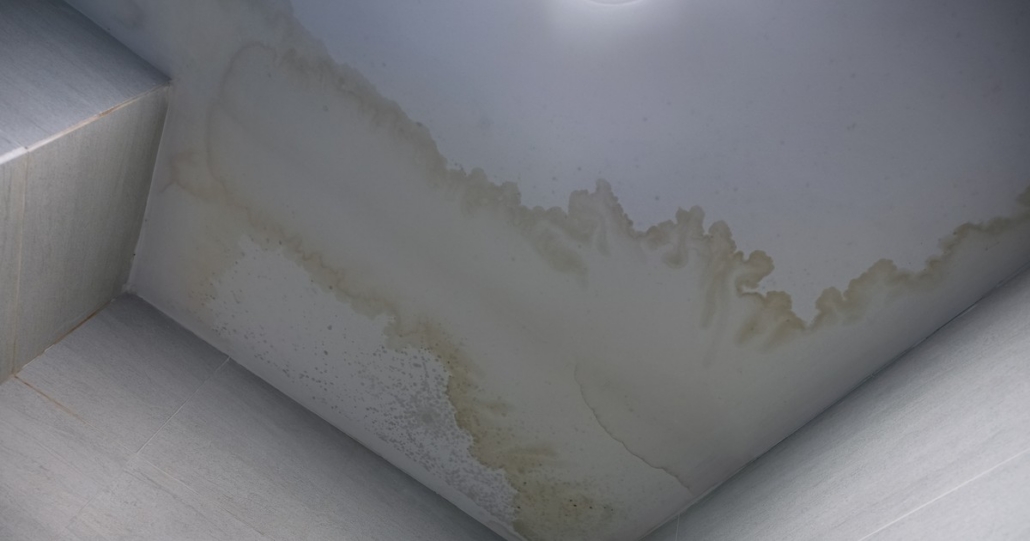
What’s That Stain on My Bathroom Ceiling?
A ceiling stain is rarely the whole story. The water may be recent or it may have been moving slowly, politely, out of sight, and the brown ring above your shower is simply the day the story surfaced. That should change how you feel about it: less alarm, more curiosity. Something up there may have been talking for a while. Today you get to find out what it’s been saying.
Is a ceiling stain an emergency?
Usually not, and the reason is odd enough to be comforting. A stain can appear long after water first entered because insulation and drywall can hide a slow leak. Nothing necessarily broke this morning. The evidence may have just cleared customs.
Chris, the owner here, once opened up a dormer wall on a job and found the framing rotted through. The homeowners had no idea. The only warning the house ever gave was a faint stain on the back of the drywall that never made it to the paint. That’s the real nature of this problem: not fast, not loud, just patient. Water soaks into the wood, dries out, soaks in again, season after season, and eventually little organisms start eating what’s left. So a stain isn’t a fire alarm. It’s a clock, and it’s been running a while. Arrange an inspection promptly. Don’t hand it another year.
The clear emergency is drywall that’s bulging, sagging, or actively dripping, especially near a light fixture. Keep people out from beneath it, shut off power to the affected area if you can do so safely, place a bucket nearby without standing under the bulge, and make the call today. A water-loaded ceiling can collapse.
Why is the stain in my bathroom, of all places?
Because one of the most failure-prone rubber parts on your roof may be parked directly over your head.
Stand in the street and look at your roofline. See the little pipes sticking up? Those are plumbing vents, and they often rise from bathrooms and kitchens. Where each pipe exits the roof, a rubber gasket seals the opening. Rubber dry-rots. Five to ten years inland, often faster out here where salt air and coastal sun accelerate exposed materials.
Here’s Chris describing the leak he’s found more than any other in eighteen years: the gasket’s dry rotted, and now the water’s just running down along the pipe and onto the bathroom ceiling. That’s it. That’s the mystery. The pipe is a waterslide, the gasket is the failed gate, and your bathroom ceiling is where the ride ends. It looks like you need a new roof. It’s a fifteen-dollar part with a great sense of drama.
Why is there a water stain when it isn’t even raining?
A stain keeps its own calendar, and reading it tells you what you’re dealing with.
Runs a day or two behind the rain? That often points to a slow roof leak. The insulation is a sponge with a delay on it; the sky performs Tuesday, your ceiling reviews it Thursday.
Ignores the rain but tracks your showers, or blooms in cold snaps? That may be condensation rather than a roof leak. Bathroom air rides the exhaust fan duct into a cold attic, condenses, and drips back down. A ring centered on the fan often points this way. Cathedral ceilings play the same trick: shore humidity plus a ceiling with no breathing room behind it makes water out of thin air, and no shingle on earth fixes that.
Ignores the weather entirely and just keeps growing? Look up. If there’s a bathroom or a water line above that ceiling, the water may never have met your roof.
Is it a roof leak or a plumbing leak? How do I tell?
The leak isn’t the expensive mistake. Paying the wrong trade to hunt it is. Sort it from the ground floor first:
What’s overhead? This is most of the answer. Attic and roof above the stain: leak or condensation. An upstairs bathroom above it makes plumbing the first suspect, and the usual suspects are the toilet’s wax ring, the shower pan, or a tired supply line.
Trace it. Take a pencil and outline the stain’s edge. Then watch what makes it cross the line: rain points toward the roof, showers point toward plumbing or steam, and cold weather points toward condensation.
Read the color as a clue, not proof. Water that traveled through wood and insulation often arrives brown with darker edges because it picked up material on the way. A clean supply-line leak may look paler, but color alone cannot confirm the source.
Test the pattern only when the ceiling is flat, dry, and electrically safe. During a dry forecast, normal use of the upstairs shower may reveal whether the stain responds. Or wait for real rain and check the attic safely instead of waiting for the ceiling to file its report.
Ten quiet minutes of this and you call the right person the first time. That’s worth more than anything else on this page.
How do I find where the water is actually coming from?
One thing to know before you climb: water lies about its address. It almost never drops straight down from the hole it entered. It runs along rafters and pipes, sometimes six or eight feet, and lets go wherever it pleases. So the wet spot is the end of the trail, not the start.
Only enter the attic if it is safely accessible, dry underfoot, and clear of electrical hazards. A rainy day may make the leak easier to trace, but use a flashlight, stay on framing or a proper walkway, and stop if access is uncertain. Find the spot above your stain, then follow dark water marks uphill along the wood until they stop. On the shore, the trail often ends at one of three doors: the vent pipe and its gasket, a valley where two roof planes meet, or the flashing at a chimney or wall. Check nearby insulation with a gloved hand only when it is safe to do so. Dampness suggests active moisture; matting and discoloration suggest an older pattern. Photograph what you find.
No attic access, or the trail wanders off somewhere you can’t follow? Fine. Even a dead-end hunt narrows the map for whoever goes up next.
Can I just paint over the stain?
Sure, and the stain may return. Paint doesn’t negotiate with water. If the source is live, the ring can bleed back through, and a heavy stain-blocker may hide the evidence while the leak keeps working, which is worse: now the problem is invisible AND unfixed.
The order that works: find the source, fix it, let the ceiling dry fully, and confirm the repair held. Then use a stain-blocking primer rated for water stains before painting, following the product instructions.
And here’s the flip that makes the paint useful: once the repair’s done, that clean white patch becomes your instrument. Next nor’easter blows through, ceiling stays white, and you have proof the fix held, for the price of a quart of primer. The stain was the evidence going in. The paint is the receipt coming out.
How much does it cost to fix a ceiling stain?
Two bills, wildly different sizes, and everyone braces for the wrong one.
Often, the source is the small bill. The gasket is around fifteen dollars. Failed caulk at a flashing is a tube of sealant. You’re paying for a person and a trip, not parts, and even most flashing rework lives comfortably in repair money. The big versions of this bill only exist when the clock ran too long: rotted decking, cooked framing, soaked insulation. Delay is what can turn a small moisture source into a major repair.
The ceiling is the cosmetic bill. Primer and paint for small stains, a drywall patch first if it sagged. A handy homeowner can do this half over a weekend.
Now the warning, because ceiling stains are a common opening for an unnecessary roof-replacement pitch. Chris tells it straight: a leak may have been running quietly for years, the roof is no longer new, you finally notice, and a salesman comes out and says you need a whole new roof. When somebody says that over a single stain, make them prove it with photos: rotted decking, failure across the roof, not just the drip you already knew about. A fifteen-dollar cause deserves a fifteen-dollar diagnosis before anyone says a five-figure number out loud.
Why do ceiling stains show up so much in Ocean City beach houses?
Two reasons, and they stack.
The first is chemistry. The parts that cause stains, rubber gaskets, exposed caulk, flashing sealant, are exactly what salt air and beach sun chew through first. From the oceanfront towers down through West Ocean City and out to Berlin, those parts can have shorter service lives than they would farther inland. Same roof, faster clock.
The second is nobody’s home to hear it. Think about how many houses out here go quiet from September to May, the rental rows, the bayside condos, the family places. A slow leak’s entire strategy is going unnoticed, and an empty house is eight months of not noticing, every single year. Which is why the Ocean City version of this story so rarely starts with “a stain appeared last week.” It starts with “we came down to open the place up for the season, and there it was.” If that’s you, the ring you found in May may have started long before you returned, and the attic above it deserves a good look for how far the water traveled while nobody was watching.
For the whole story of what this coast does to a roof, the salt, the wind, the humidity, and the ice, read our guide, Roofs on the Shore.
The three photos that end it
When the source is a dry-rotted gasket, here’s how this story is supposed to finish, and it’s Chris’s favorite part of the job. The technician finds it, photographs it, replaces it, seals it, and shows you three pictures: here’s how the old one looked. Here’s the new one going on. Here’s it done. You should be good.
That’s the ending, certainty, with receipts, and it’s what the Gutter Cleaning and Roof Tune-Up is built to deliver. Pricing starts at $199 for homes with two levels or fewer above ground and is $324 for three-story homes. The homeowner must be present for the appointment. An AROCON roof technician or team inspects the roof and the attic where access is available, and the usual minor maintenance items are already in the service: one deteriorated pipe gasket, caulking and sealing of vents, flashings, and nail holes, loose shingles tightened, and nail pops repaired. The roof and gutter system is blown off during the same visit, and you receive 30–40 photos of the roof, attic, and gutters, including before-and-after photos of completed work.
And if the answer turns out to be condensation, or plumbing, you’ll be told exactly that, because we’d rather lose a repair than sell you the wrong one. Either way, you leave with documented direction instead of the wrong repair.
→ Book the Tune-Up — Starting at $199
Do this today
- Check the ceiling itself. Bulging, sagging, dripping, or water near a light fixture: keep people out from beneath it, shut off power to the affected area if safe, and call today. Flat and dry: you have time, use it well.
- Answer one question: what’s above the stain? Bathroom above means plumbing first. Roof above means leak or condensation.
- Pencil the stain’s edge and note what makes it grow. Rain, showers, or cold. That single observation picks the right trade.
- If it points at the roof and you can reach the attic: rainy day, flashlight, framing only, follow the marks uphill.
- Leave the paint in the garage until the source is fixed, the ceiling is fully dry, and the repair has been confirmed. Then use stain-blocking primer before painting.
- Close it out this month. The source may stay small for a while. The damage doesn’t.

